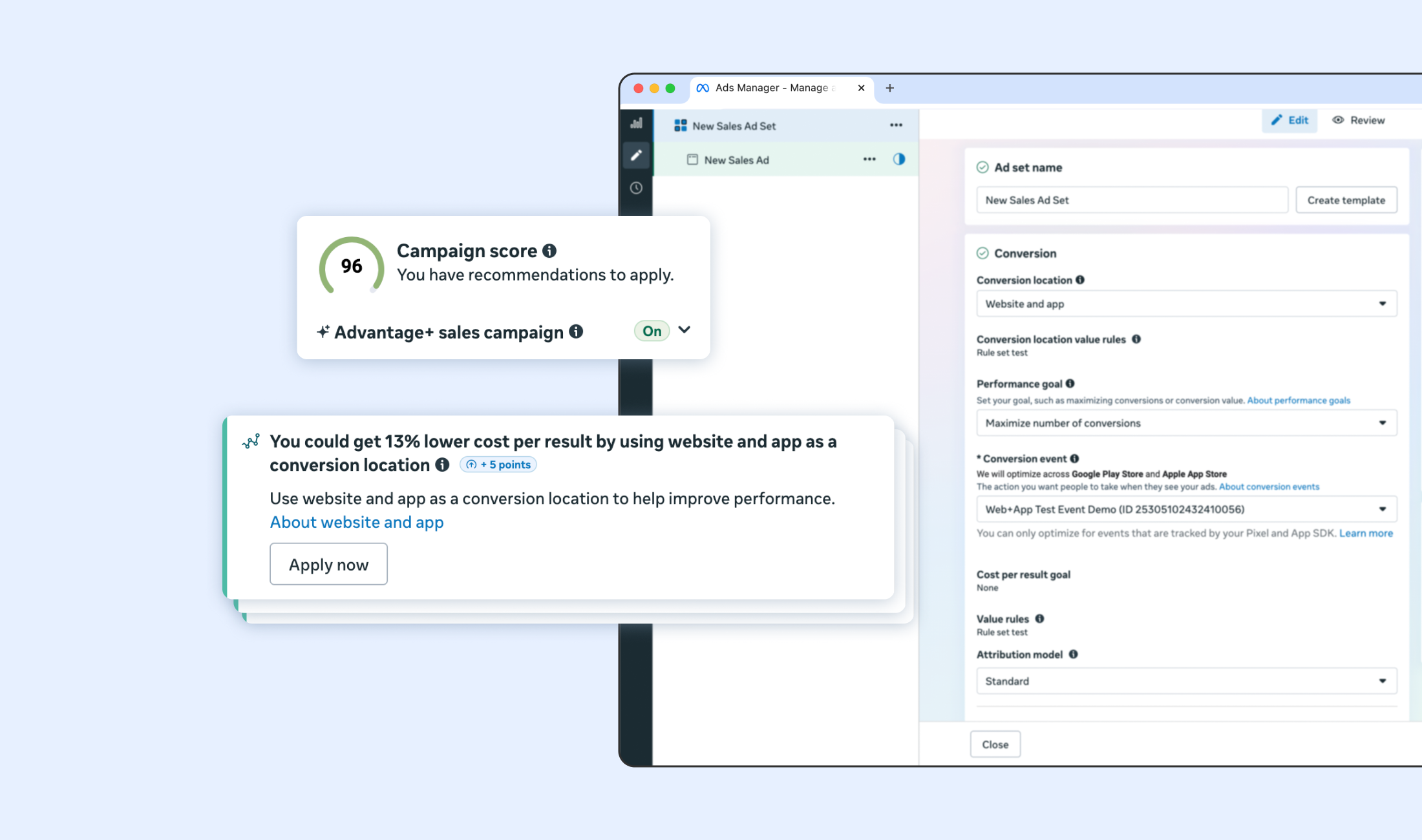
Most small businesses run their own Meta ads without an expert on staff, and small setup mistakes quietly waste their budget. Recommendations are small cards in Ads Manager that spot a problem with a running ad and suggest a fix: “These three ads are competing with each other, combine them into one.”
As the lead designer for ad recommendation, I drove the design strategy shift with Meta AI, product growth through large-scale testing and fast iteration, and collaboration & alignment with 20+ partner teams.
Impact
{{ adoptText }}
average recommendation adoption rate
{{ effText }}
lower cost per result for advertisers
{{ revText }}
direct team revenue increase
Duration2024 – 2026
My roleProduct Designer
TeamPM, Engineer, Data Scientist
LocationBellevue, Washington
Problem
Users need help troubleshooting setup, but recommendations aren’t helpful
Small and medium business (SMB) owners often get lost on the complex Meta ads platform, and see low results caused by poor setup. Recommendations are designed to troubleshoot. But advertisers don’t trust them and keep ignoring them. The average adoption rate was 2%.
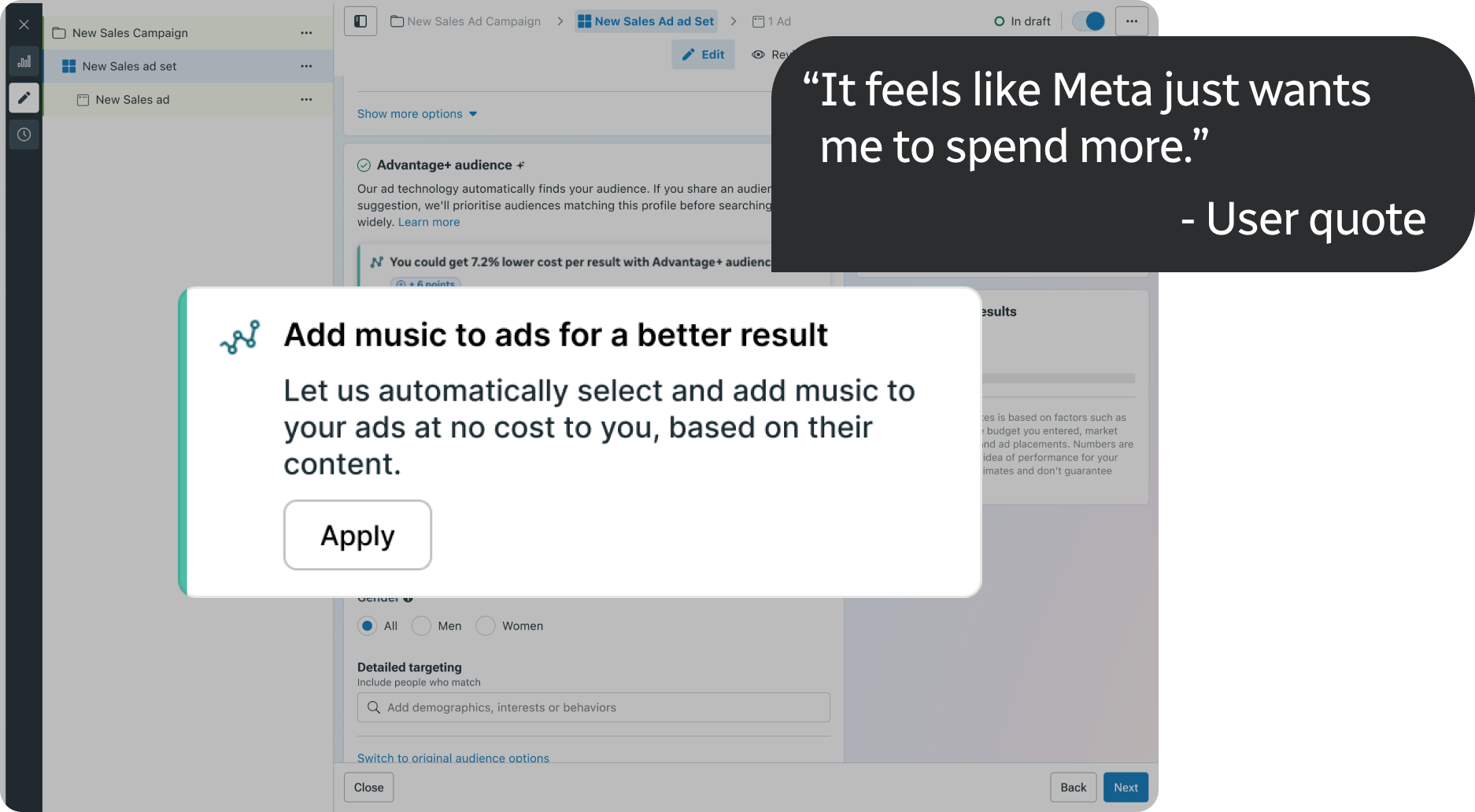
Spammy upsell
Promoted Meta products instead of fixing the advertiser’s problem.
General solution
The suggestion was shown to wide eligibility whether or not it matched their real problem.
Recommendation before
USER PROBLEM
Small advertisers often get lost in complex settings, and having low ad results
Small and medium businesses (SMB) set up their own Meta ads without an expert on staff, some setups is hurting ad performance.
01
High spend, low return
Poorly set-up campaigns cause an average of 17% higher cost per result.
02
Suboptimal setup
Conflicting settings and missed best practices slip in during ad creation without advertisers noticing.
03
No way to diagnose
Small businesses cannot tell which setting is to blame or how to fix it.
Design strategy shift
Redesign to earn trust From one-click to deep insight
01
I designed new recommendations that focus on common setup issues advertisers really care about, and propose solutions for them.
Dogfooding
100+ accounts to understand real use cases
Data analysis
Understand drop-off and experience gap
A/B testing
Validate design hypotheses at large scale
Experiment
Move fast with 3 iterations in 5 months
SOLUTION
Lead with real issues
Lead the recommendation with performance issue advertiser can see themselves, so it resonates.
Show up at the right moment, at the right place
Appears contextually at the time and place the issue happens, when it is most relevant and easiest to fix.
Preview modal for transparency
For complex fixes, a one step modal previews exactly what will change before advertisers confirm.
Solution 1
Clear problem diagnosis so it resonates
Model-detected segments turn one generic suggestion for a million advertisers into a diagnosis each one recognizes and acts on.
Solution 2
Show up wherever the issue happens
The card used to only live in two places. Now it meets advertisers where they need it across the whole journey.
Contextual triggering
The card appears at the setting that caused the issue, from campaign table to ad set editor to account overview
Cross-team alignment
I led the work with the system team and each surface owner to open new entry points on their surfaces
Design system extension
Grew the card from 2 variants to 6, fitting into each entry point, all on one shared anatomy
Solution 3
Customized solution that fits each user
One-size solution often goes against user intention. Now advertisers compare multiple solutions and choose the best-fit one with a result forecast.
{{ s1LaunchText }}
new recommendation launched
2%→{{ s1AdoptText }}
average recommendation adoption rate
Horizontal collaboration
Scale the number of recommendations 10x with AI design agent
02
Challenge
As recommendation adoption rate improved, 20+ partner teams wanted to create their own recommendations, far more than one designer could make by hand.
Solution
So I defined a recommendation design system and an AI knowledge hub, to support partner teams launching high quality recommendations on their own, increasing design velocity by 70%.
Before
Design execution by myself
From designing every recommendation myself to a consulting role supporting more recommendation requests.
→
Then
Consulting role with design system
Distilled the design system into a playbook and office hours.
→
Recently
Build agent to accelerate scale
I built an AI bot with data, past context, and Figma prototypes, so teams launch without waiting on me.
It answers partner team questions from past Q&A, with every standard resource linked, so collaboration moves faster.
It lets partner teams visualize the new recommendation experience end to end before writing a single spec.
40→{{ scaleNow }}
recommendations shipped
Recommendations everywhere becomes noise, so I focused them into one hub
03
PROBLEM
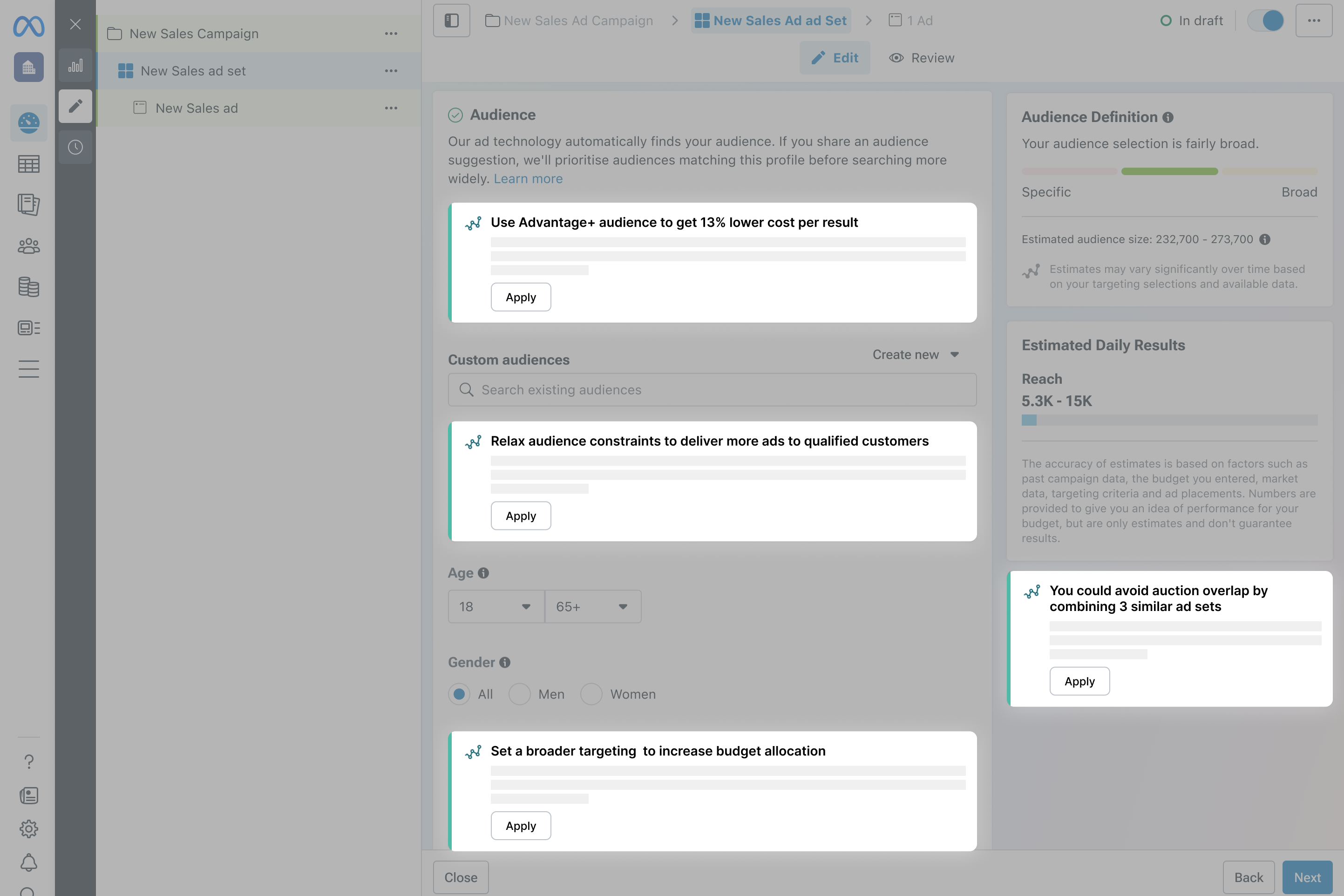
Advertisers stopped paying attention with banner blindness
Overall adoption growth slowed, and new recommendations barely got adopted. Research pointed to recommendation blindness: with too many recommendations floating around the platform, advertisers had tuned them out.
Too many at once
Recommendations showed up in every setting, feeling spammy and overwhelming.
One-size answers
Some solutions did not fit the business’s limitations or intent.
No proof
Advertisers could not tell if adopting one would actually improve performance.
Solution
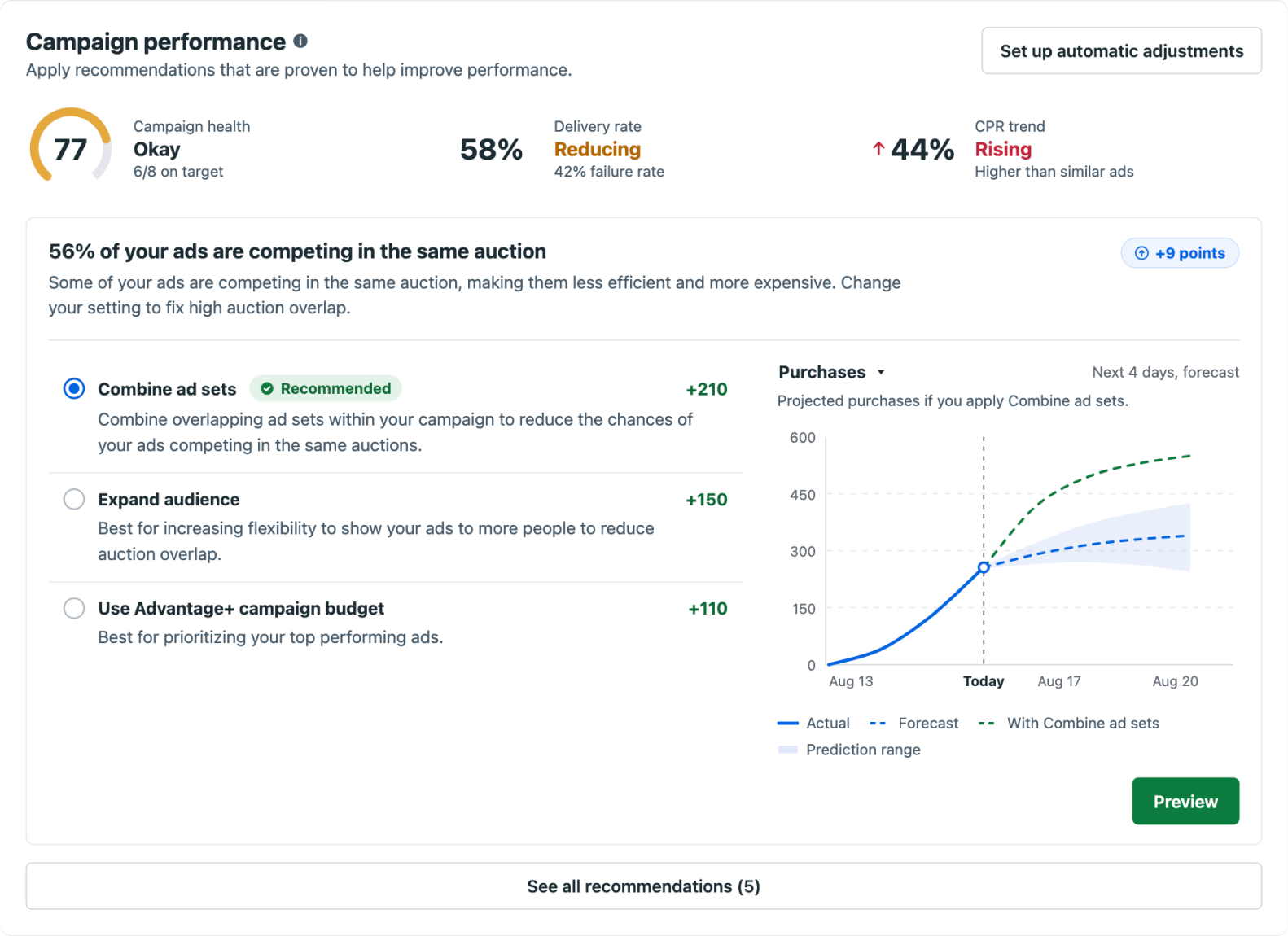
I redesigned the experience so each complaint got a direct answer: a performance overview cuts the noise and surfaces only the recommendations that matter most, multiple solutions let advertisers choose what fits their business, and a forecast per solution shows the expected impact before they apply anything.
Clear diagnosis — Surfaces campaign health, delivery, and cost, and highlights the one issue hurting performance most.
Multiple solutions — Options instead of one forced fix, so advertisers choose what fits their business.
Forecast result — Projects how each option will change performance, giving advertisers confidence to act.
4%→{{ s3AdoptText }}
average adoption rate of top recommendations
Led design vision
Vision with Meta AI — Move recommendations upstream to prevent issues in planning stage
03
PROBLEM
Fixes arrived only after budget was wasted
Recommendations, at their best, were still reactive. A card appears only after an ad underperforms, which means some budget is already gone. The end goal was never faster fixes. It was making fixes unnecessary.
Solution
So I folded the strategy into Meta’s AI vision: an assistant that monitors campaigns, catches issues before they surface, diagnoses the cause, and applies the fix with one-click approval. Small businesses get expert-level corrections without hiring an expert.
The next step moves recommendations upstream into campaign planning with Meta AI. Advertisers preview how different settings will perform and land on the setup that matches their intent, before a single dollar is misspent.